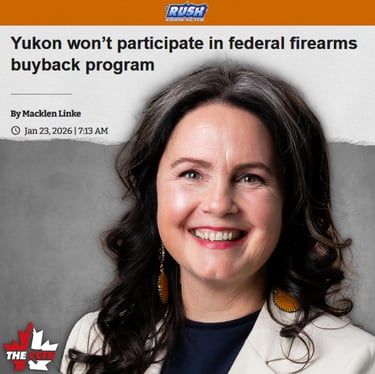
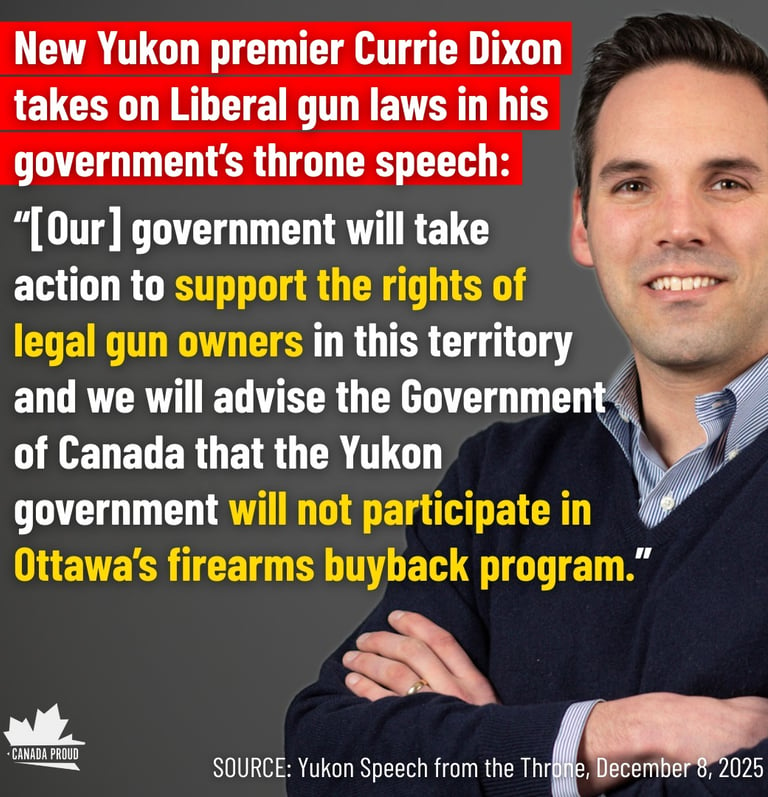
The release statement from Laura Lang Minister of Justice and the Yukon's Attorney General, makes clear the government is using a contested federal firearms policy as a platform to build new Yukon-controlled institutions and influence things that can translate into money, jobs, and political leverage.
It was never about the gun owner's, it's about capitalizing and taxing you for your rights
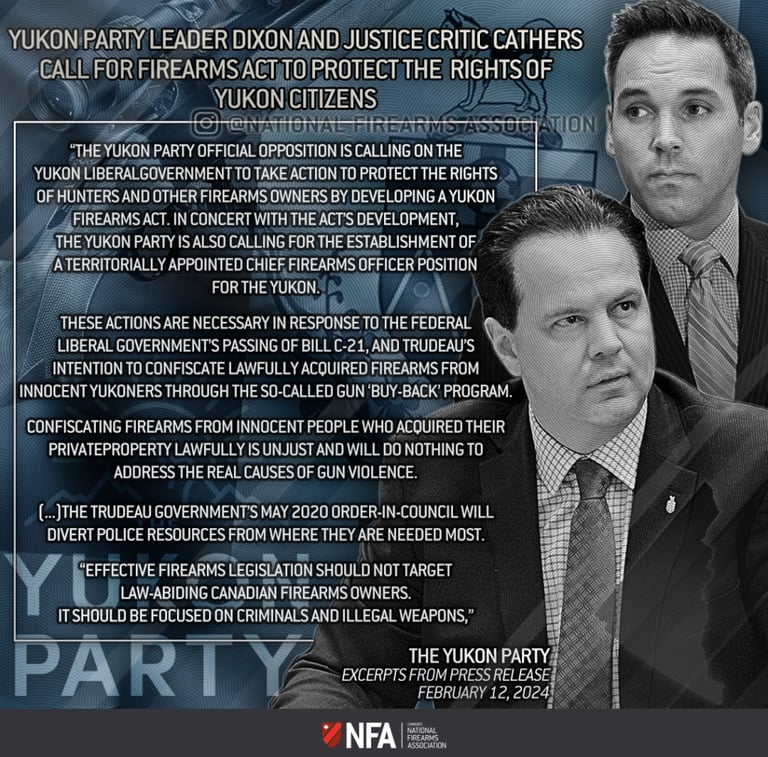
The Yukon government is trying to profit from the issue, framed as “political/institutional gain” rather than claiming illegal behavior:
The release statement from Laura Lang Minister of Justice and the Yukon's Attorney General. makes clear the government is using a contested federal firearms policy as a platform to build new Yukon-controlled institutions and influence things that can translate into money, jobs, and political leverage.
It moves from advocacy to creating new funded positions Lang says the legislation is meant to “explore the creation of a new firearms advocate position.” That’s a new government-backed role (plus mandated advice and the ability to support training/education). A common “profit” framing is: instead of only defending Yukoners, the government is creating a new piece of government machinery that can bring ongoing salaries, budgets, and program funding tied to the firearms file.
It uses a time-limited “engagement” to legitimize a decision already in motion Lang repeatedly emphasizes limited time before tabling legislation “this fall,” and then states the firearms legislation will “allow us to explore” the advocate role. Critics can argue the “summer engagement” is partly about collecting public endorsement for an institutional change the government already intends to pursue—so public input becomes a legitimizing step, not a true choice.
It anchors the effort in federally driven money/programs while insisting Yukon won’t fund enforcement Lang notes they received confirmation that “no territorially funded police services” will be used for the federal Assault-Style Firearms Compensation Program, while the Yukon is developing its own legislation and a territorial advocate role. The attack angle: they avoid direct policing costs, yet still position the territory as central in the firearms conversation—helping them capture influence and resources through other channels (appointments, training/education programming, advisory roles).
The “northern context” and “representation” language can be read as political branding Lang argues for a “new chief firearms officer position dedicated to the territories” and says the northern dedicated officer would have “northern experience” and connections across communities (including NWT and Nunavut). A “profit” argument here is political: the Yukon is leveraging “northern representation” to increase its standing and bargaining power with Ottawa, which can bring future influence and support—benefiting the government even if it’s not direct personal financial profit.
Unanimous motion + joint concerns are used to justify expanding Yukon’s role The release points to Motion No. 54 passing unanimously and to joint concerns with NWT and Nunavut. Critics can argue that’s not just advocacy—it’s an attempt to make it harder to oppose the Yukon government’s expansion of firearms-related governance (advocate position, training/education support, and legislative changes) by portraying it as broad consensus.
So The Yukon Party Government disagrees with the federal government gun legislation but wants to create it's own.
So bottom line if you want to keep your right in Yukon you have to pay for them. NOT SURPRISED 🤨